

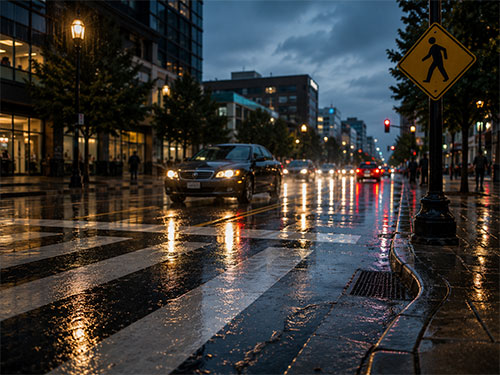

A pedestrian accident at an intersection is not resolved simply by asking whether painted stripes were present. Vehicle Code 21950 addresses yielding in marked crosswalks and unmarked crosswalks at intersections, while preserving duties of care for both drivers and pedestrians.
The driver’s crosswalk duty
Subdivision (a) requires yielding to pedestrians crossing within marked crosswalks and unmarked crosswalks at intersections, subject to the chapter’s other provisions. Subdivision (c) requires due care when approaching a pedestrian in those crosswalks, including slowing or taking other necessary action to protect the pedestrian. Whether the location was a crosswalk should be established from the road layout and applicable definitions.
Pedestrians also have duties
Subdivision (b) does not permit a pedestrian to suddenly enter the path of a vehicle so close that an immediate hazard is created, or unnecessarily stop or delay traffic in a crosswalk. The section also makes clear that those pedestrian duties do not relieve drivers of their own care obligations. Neither “pedestrians always win” nor “the pedestrian stepped out” is a complete fault analysis.
Marked, unmarked, and signal-controlled crossings
Photograph the intersection approaches, sidewalks, markings, pedestrian signals, and vehicle signals from safe locations. The absence of paint does not by itself settle whether an unmarked crosswalk exists. A controlled crossing may involve additional signal rules. Do not apply this section as though every crossing anywhere on a road has identical legal treatment.
Visibility and the approach timeline
Lighting, parked vehicles, sight obstructions, weather, travel speed, and turning movements can affect what each person could observe. Identify where the pedestrian began crossing and where the vehicle was at that time. A driver’s statement that the pedestrian was not seen should be compared with the available sight lines and other evidence, not accepted as the final answer.
Preserve more than the point of impact
A camera covering the approach may show when the pedestrian entered and whether the vehicle slowed. A recording of only the impact can omit key context. Preserve original photographs, clothing and personal items when relevant, witness names, and the collision report. Medical records should document symptoms, treatment, and functional limitations accurately; serious injury does not eliminate the need to investigate the sequence.
Fault and recovery remain fact-dependent
Several acts may contribute to a pedestrian collision. The statutory rule can inform a negligence claim, but causation and the applicable legal requirements still matter. Comparative fault can affect recovery where supported by the evidence. A claim also needs documentation of medical expenses, income loss, and other compensable harm, rather than a promised value based only on the crosswalk location.
Questions to organize your records
- Was the location a marked or unmarked crosswalk?
- What signals governed the crossing?
- When could the driver and pedestrian see each other?
- Is there footage of the approach as well as impact?
Official statute and related guidance
Read Vehicle Code 21950. For the standards governing a presumption based on a statutory violation, see Evidence Code 669.
Also read our Vehicle Code accident overview, our comparative-fault guide, and our guide to collision reports and fault.
Resources for your next step
If you were injured while crossing the road, explore our pedestrian accident representation.
Discuss your accident with Weiss Attorneys
For a review of the collision and injury records, learn about our California car accident representation, read Scarlett Farrokh’s attorney profile, or request a consultation. Call (213) 583-0977. This guide provides general information; the applicable law, deadlines, and remedies depend on the facts.