

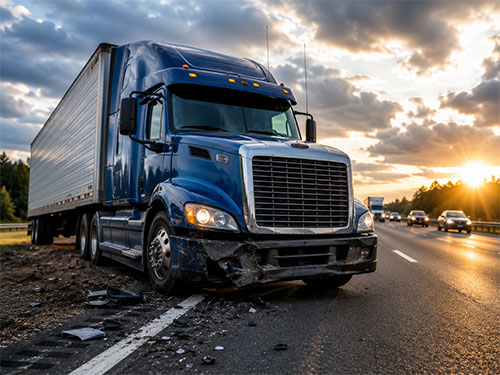

A truck collision can generate evidence in several places: the vehicle, the driver’s device, the carrier’s systems, a shipper’s records, and nearby cameras. A photograph of the truck may establish its appearance but not which company controlled the trip. Early identification and preservation can make later investigation more effective.
Identify the vehicle and the trip participants
Preserve photographs of the tractor, trailer, company markings, license plates, and any visible USDOT number. The tractor and trailer may have different owners. A company name displayed on a vehicle does not automatically establish every employment, ownership, or contractual relationship involved. Keep the crash report and information exchanged at the scene so counsel can investigate the actual roles.
Records worth evaluating
- Driver duty records and supporting documents, where applicable.
- Dispatch messages, route information, delivery schedules, and shipment records.
- Dashcam or other video, including footage from nearby businesses or vehicles.
- Vehicle electronic data and telematics, if the equipment records relevant information.
- Inspection, maintenance, repair, and post-collision examination records.
- Photographs and information about cargo, load placement, securement, and trailer condition when relevant to the collision.
Not every truck has the same equipment or records. An electronic logging device, a dash camera, and an engine control module perform different functions. Do not assume that a vehicle has a universal “black box” containing a complete accident reconstruction. The equipment and the available data must be identified.
Federal retention periods are not all the same
For motor carriers subject to the applicable rules, 49 CFR section 390.15 requires an accident register for qualifying accidents for three years and addresses retention of specified accident reports. Section 395.8(k) generally requires retention of records of duty status and supporting documents for at least six months from receipt. These provisions have distinct scopes and do not mean that every video or electronic file must be kept for three years.
A routine retention period is also different from a case-specific obligation to preserve relevant evidence. The applicable rules, exceptions, and circumstances should be reviewed rather than using one period as permission to destroy records or as a guarantee that records still exist.
Make a preservation request specific
A useful request identifies the collision date, approximate time, location, involved vehicles, and the relevant categories of evidence. It can ask that original files, associated metadata, and potentially relevant equipment be preserved. Address it to the appropriate parties as they are identified. Keep a copy and proof of delivery.
A preservation letter is not a court order and does not automatically compel production. Obtaining the records may require agreement, an appropriate subpoena, or litigation discovery. The request should distinguish preservation from inspection or access so that the recipient understands what is being asked.
Preserve evidence you already control
Back up your own dashcam files and photographs without deleting originals. Keep towing, repair, storage, and insurance correspondence. Discuss inspection needs before a vehicle is repaired, sold, or scrapped. Do not enter another party’s property or attempt to access its systems yourself.
What if records are already missing?
Document what was requested, when, and what the response said. Missing evidence does not automatically prove negligence or guarantee a favorable court ruling. Other records may establish the same facts, and the significance of any loss depends on the circumstances and governing law.
Federal sources
49 CFR section 390.15; 49 CFR section 395.8.
Discuss your claim with Weiss Attorneys
Bring the relevant records, insurance correspondence, and any proposed settlement documents to a consultation. Weiss Attorneys can evaluate the available evidence and the questions specific to your situation. Learn about our related injury representation and local accident resources.
Read Scarlett Farrokh’s attorney profile, request a consultation, or call (213) 583-0977. This article provides general California information; the applicable rules depend on the facts, coverage, and deadlines of the particular claim.