A California collision report may identify a Vehicle Code section beside an officer’s explanation of the crash. That number points to a driving rule. It does not, on its own, decide an insurance claim, prove every element of civil liability, or establish what an injured person will recover. This guide connects eight relevant traffic rules […]
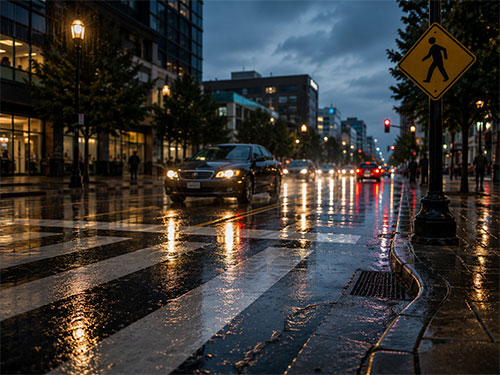
A pedestrian accident at an intersection is not resolved simply by asking whether painted stripes were present. Vehicle Code 21950 addresses yielding in marked crosswalks and unmarked crosswalks at intersections, while preserving duties of care for both drivers and pedestrians. The driver’s crosswalk duty Subdivision (a) requires yielding to pedestrians crossing within marked crosswalks and […]
A driver looking down before impact may raise a distraction question, but suspicion is not proof of a particular phone violation. Vehicle Code 23123.5 addresses holding and operating handheld wireless communication devices while driving. An injury investigation must identify the actual conduct and its connection to the collision. What the handheld-device rule covers The statute […]
A stop-sign crash may involve a driver who never stopped, stopped beyond the proper location, or stopped but then entered unsafely. Vehicle Code 22450 addresses the stopping requirement. Right-of-way and the safety of entering the intersection can require additional rules and evidence. Where must a driver stop? For a stop sign at an intersection, section […]
“I had the green light” is a common account after an intersection crash. Vehicle Code 21453 describes duties at red signals, including distinctions between a circular red light and a red arrow. Identifying the actual signal and movement is essential before drawing conclusions from that account. Stopping at a circular red signal Subdivision (a) requires […]